Dear colleagues,
A discussion has recently gained momentum about replacing the familiar term benign paroxysmal positional vertigo (BPPV) with peripheral paroxysmal positional vertigo (PPPV). I share the widely held view that BPPV is frequently not “benign” in the everyday clinical sense. Patients can suffer prolonged disability, recurrences, and a substantial impact on quality of life. On that point there is little disagreement.
The question is whether a change of name solves more problems than it creates.
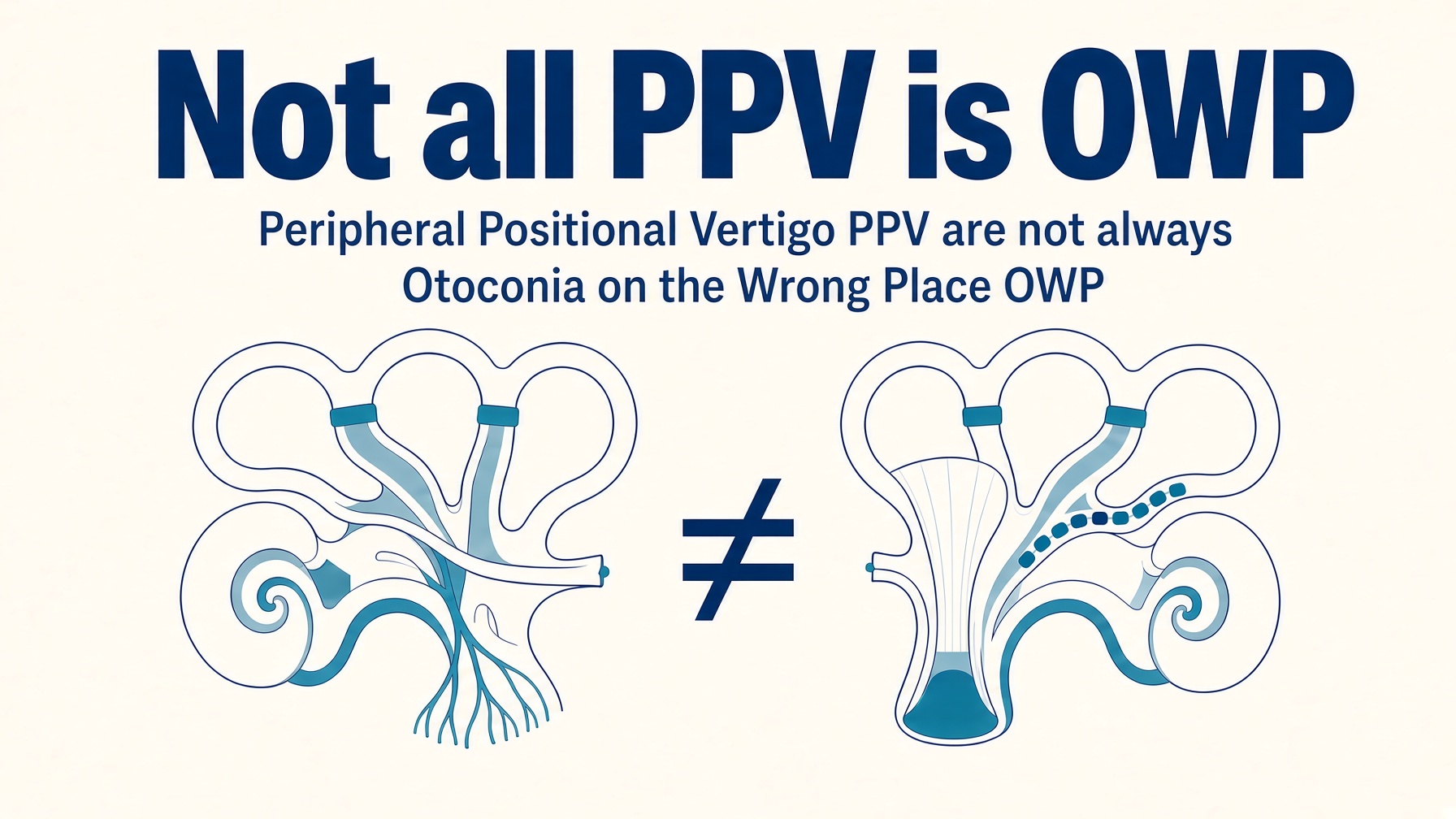
Central positional vertigo (CPV) is not a single disease. It is a clinical phenomenon that occurs in a variety of central vestibular disorders. BPPV, by contrast, is a specific diagnosis: otoconia that have left the utricle and entered a semicircular canal or become attached to the cupula (otoconia in the wrong place). Simply substituting “peripheral” for “benign” implicitly presents canalithiasis/cupulolithiasis as the only form of peripheral positional vertigo (PPV). Yet we already recognise other peripheral mechanisms: light cupula, heavy cupula unrelated to otoconial attachment, and it is reasonable to expect that further entities will be described. A name that locks the diagnosis to one pathophysiology makes it harder, not easier, for future work to classify additional peripheral positional syndromes.
There is also a practical, human argument for retaining the word “benign.” Even when we know the condition can be troublesome, patients often find genuine reassurance in hearing that their diagnosis is called benign. The adjective does not prevent us from explaining the real burden of the disease; it does, however, make the first conversation less frightening and, in a modest way, therapeutic. Medicine already lives with other imperfect “benign” labels (benign intracranial hypertension, benign prostatic hyperplasia, benign recurrent intrahepatic cholestasis). We have not felt compelled to rename them all.
If a change of nomenclature is nevertheless judged necessary, I would argue against a near-synonym such as PPPV or PPV. Small lexical shifts of this kind tend to generate more confusion than clarity — in the literature, in teaching, and at the bedside. A cleaner solution would be a name that states the mechanism directly and leaves room for related but distinct entities. My working suggestion is OWP — otoconia in the wrong place. It is transparent, mechanism-based, and does not pretend to cover other peripheral positional vertigo syndromes.
A change of name is not a cosmetic detail. We already have a cautionary example in persistent postural-perceptual dizziness (PPPD). The term is cumbersome in daily practice, difficult to pronounce, almost impossible for patients to remember, and of little help in explaining their condition. I often find myself apologising to a patient for the name of their condition and explaining that I was not the one who gave it that name. A new designation for BPPV should not repeat that mistake.
I offer these remarks not as a claim of authority, but as the view of a clinician who has spent almost twenty years in neurotology and has treated more than five thousand patients with positional vertigo. Terminology is not a trivial matter: a shared nomenclature helps colleagues across the world understand one another, exchange clinical and scientific experience, and build the next generation of knowledge. Above all, clearer language serves our patients. Disagreement on a name need not become disagreement among colleagues.